From Our Readers: The Light Inside the Bookshop - In Memory of Michal Ženíšek
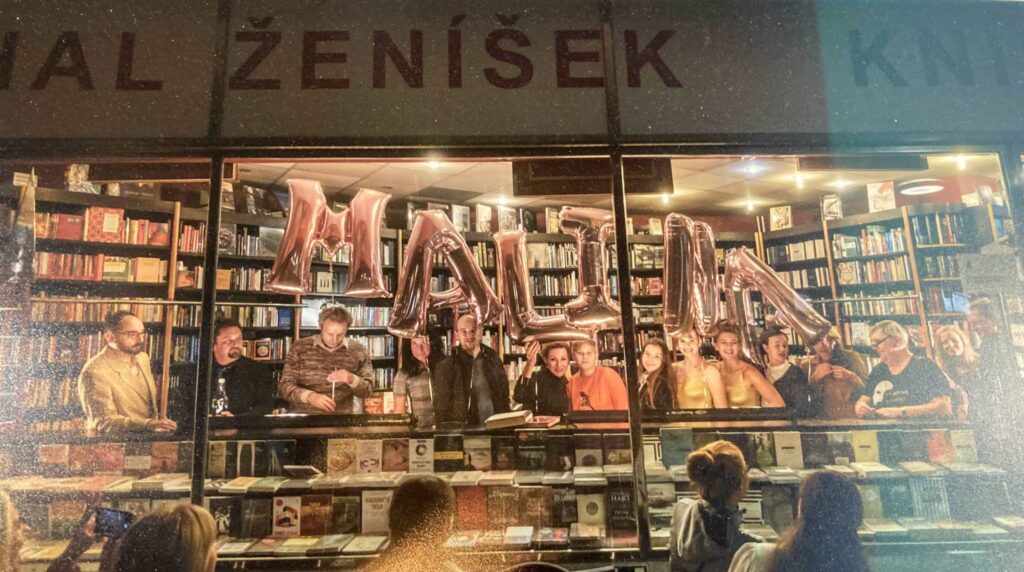
Written by Cosmi Tcaciuc, an expat from Brno. Find the first article in this “mini series” here: How I Discovered Brno’s Legendary Bookstore and Its Equally Legendary Owner.
When a former employee returns to the first privately owned bookshop in former Czechoslovakia just days before its closure, she finds herself helping its legendary owner say goodbye. Written before the passing of Michal Ženíšek, this personal narrative reflects on memory, impermanence, and the quiet moments that shape a city’s soul. It is published now in memory of one of Brno’s most beloved booksellers.
Michal Ženíšek passed away in Brno on 28 July 2026.
Feature picture credit: Institut Paměti Národa
This is a story I think you should know—because if you don’t, you might not truly understand what Brno is about. There are stories that could only unfold in this city, and this is one of them.
It’s January 2023, and we’re in the heart of Brno, in the Alpha Passage—a corridor many locals pass through daily, though they may not always notice what lives and dies within it. Today, it’s particularly crowded, thanks to the city’s ongoing flea market ritual, or “blešák,” as my Czech friends call it. Dozens of local vendors have set up tables of who-knows-what—items discarded by others and now waiting for a second life. Hunting for tchotchkes here has long been one of my favorite pastimes.
As I’m bargaining over some small trinket, my attention drifts to the windows of a bookstore that had just closed its doors forever: the first privately owned bookshop in Czechoslovakia, or so its owner, Michal Ženíšek, proudly claimed. Now, a large, visually striking poster covers the glass, asking: “Where will the soul of Michal Ženíšek’s bookstore go?” I assume it’s the work of some local young people, hoping to show support. But it’s not just about this shop. The poster also mourns the loss of other Brno landmarks, like the once-iconic Švanda pub, a casualty of the COVID era.
Švanda wasn’t just a name I knew. Like most locals, I had my own history with Švanda —it was a corner of my youth, echoing with laughter and bad beer. But standing now in front of the shut-down bookshop, I feel something heavier. This one hit closer. I had come to it late—only stepping inside in 2021, near the end of its run, working a few shifts as a holiday assistant. And yet, the place stuck with me. Or rather—he did.
Pan Ženíšek, as we called him, was a man in his late sixties—and the first to privately own a bookshop in this country. He opened the store in 1989, right after the fall of communism, leaving behind a career in opera that never fully took off due to health issues. Those same issues still lingered, forcing him to rely on the help of occasional assistants like myself.
I was in my early thirties then, working alongside university students, trying to figure my way out of a pre–midlife crisis—while Pan Ženíšek was quietly navigating a crisis of his own: that of a man staring down retirement.
Maybe that’s what made him swing so effortlessly from mischievous to melancholic, or maybe it was simply his theatrical flair, rooted in that abandoned opera past. Česká Televize even made a documentary about him, fittingly titled The God of Books (Knihkupec boží). He delivered the role of his life in that film—just as he did every day behind his desk, tending to books and bantering with visitors.
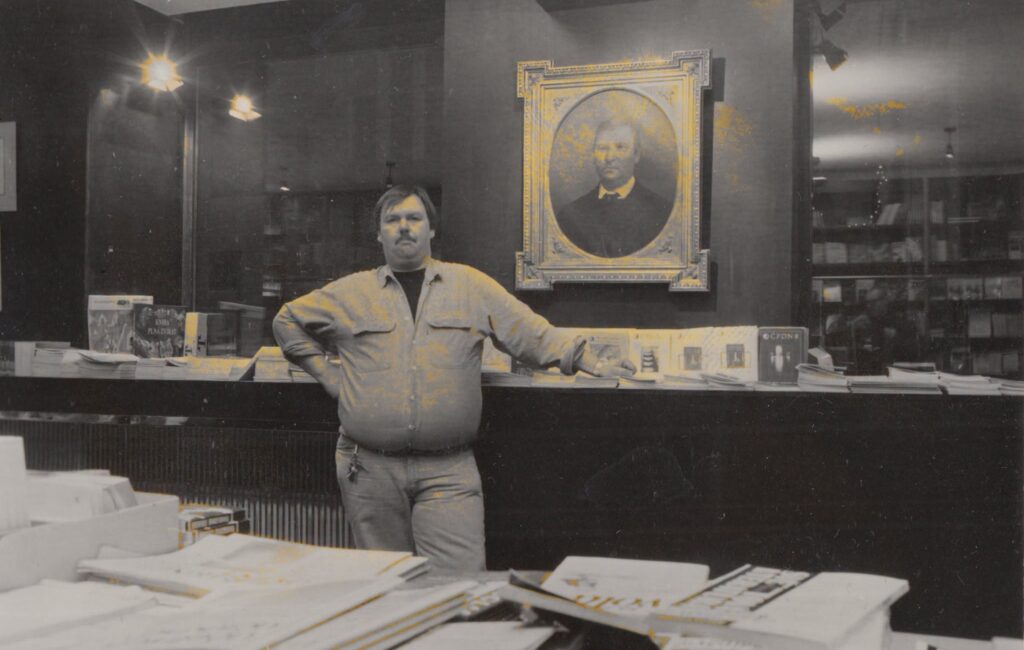
Photo credit: Institut Paměti Národa
He was never just selling books. He was performing—clinging to something the city, perhaps, was already letting slip away.
I remember how on my first day at the job, he eagerly showed me the contents of an old suitcase by his desk—a set of vintage train toys he said were a gift from his father. While he spoke with visible affection about it, I couldn’t help but wonder why he kept such a cherished memory in the shop. Soon, I began to notice the bookstore was scattered with other personal objects—things that no longer had a place in his apartment just one floor above. One of such items was a wall clock that no longer kept time, but Pan Ženíšek never bothered to fix it; practicality simply wasn’t his style..
That same attitude extended to how he ran the bookshop. There were no clear shelf displays or labels; the books were arranged according to a logic none of the staff could understand. I once stumbled upon an Italian-translated biography of the famous Czech athlete Emil Zátopek buried among a stack of unrelated titles. The disorder often confused customers, who assumed they’d wandered into an antique shop. Much to my amusement, this infuriated Pan Ženíšek, who longed for the store to be seen as a proper bookstore—which, of course, it wasn’t.
I often felt more lost in the shop due to the language barrier. There were many times when I wasn’t sure I understood the title of a book a customer was asking about. Fortunately, Pan Ženíšek was usually nearby, overhearing my limited exchanges with customers and stepping in to help. But he never scolded me for my poor Czech; if anything, he was more annoyed by my inability to stack the books properly. As for my Czech, it often seemed to entertain him—especially when he’d send me off to buy him meruňková plundra and I’d return with meruňková kapsa (even now, I still don’t quite understand the difference). Perhaps I projected onto him a paternal figure, all forgiving and caring. I also felt that I held a special place in his heart, as he sometimes tried to mimic my unusual laughter in an endearing way.
Pan Ženíšek talked often of regrets, especially the absence of grandchildren. Maybe that’s why, one day in the shop, he awkwardly introduced me to his only son. He had previously joked about me joining the family as a daughter-in-law, and now seemed pleased to finally make the introduction. The matchmaking didn’t take, though it amused my coworkers. Later, perhaps more sincerely, he floated another idea— that of me buying the shop from him upon his retirement. I laughed it off, but deep down, something about it stuck. I was in a personal limbo, unsure of where to go next. The thought of anchoring myself in Brno, of inheriting a piece of its soul, felt strangely tempting.
Fast forward to that cold January day in 2023. The bookstore is officially closed, yet I see a light on inside. Peeking through the window, I spot Pan Ženíšek in his usual corner, the glow of a screen lighting his face, a cigarette in hand. He waves me in.
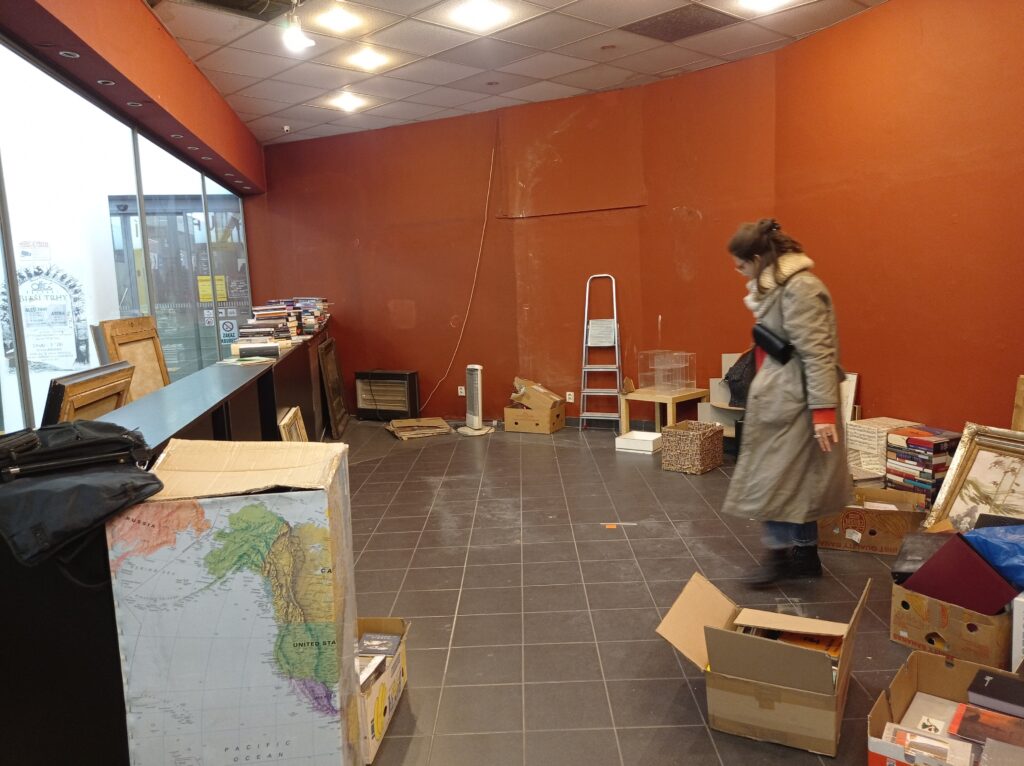
I am used to seeing him there, behind his computer, but now the shop feels eerily hollow. The shelves are gone. The books are gone. Only his desk and his paintings remain—his odd, curated collection of framed landscapes still covering the walls like memories refusing to leave.
The quiet, dim interior clashes with the chaos just outside, where people bustled past, buying and selling merchandise. I know the shop was set to close in January—a mix of Pan Ženíšek’s impending retirement, the landlord’s increase in rent, and the growing dominance of large competitors. He had, essentially, been pushed out of business. Even now, I still don’t know how he managed to pay me and the others what he promised, especially on days when we barely sold a single book.
We had tried to convince him to adapt—to make small changes that might help the shop survive—but he would nod politely, then continue as always, committed to doing things the only way he knew.
“Pan Ženíšek, wasn’t the shop supposed to be closed by now?” I ask, puzzled.
“On Monday,” he replies, sounding somewhat defeated.
More than twenty paintings were still hanging on the walls—some large, some small. I begin to worry he wouldn’t manage to take them down by Monday, especially given the way he was dragging himself around. So I offer to help. He agrees, passively, and watches as I begin removing them.
I want to slow down, to offer him some comfort. But I am gripped by a sense of urgency—as if this last fragment of the bookstore needs to be dealt with quickly, before it, too, vanishes.
While I climb on chairs to reach the higher paintings, two friends show up for the flea market. I wave them in, desperate for backup. They come not just with energy, but with an idea: why not try to sell the paintings? After all, we’re in the middle of Brno’s most eclectic market.
Pan Ženíšek shrugs, then agrees, still staring into his screen as if it’s just another ordinary day in the bookstore. After some effort, we carry the paintings out and set them up just outside the now-empty shop. Almost immediately, an antique vendor inspects them like a shark. He offers 2000 CZK for the whole batch. We’re ready to say yes, but from inside his chair, without moving a finger, Pan Ženíšek firmly declines the offer.
I feel a flush of embarrassment. To us, they’re just old paintings. But to him, they’re chapters of a story—his story—and perhaps of Brno’s.
More offers follow. He declines again and again, until we finally convince him to set the prices himself. We categorize them by frame size, and slowly, the sales begin. Each time, we make sure to mention that these are the paintings that once adorned the walls of the first privately owned bookstore in Czechoslovakia—though we’re not sure the customers fully register this as they make their purchases. Most seem more focused on choosing something that would look good in their homes. One particular foreigner, who bought two paintings, appeared mildly intrigued by the story we shared with him—that kind of distant curiosity people tend to have when they’re far from home.
The day passes in this quiet rhythm—bargaining, wrapping, retelling the same story.
By the end of it, about two-thirds of the paintings are gone. As it becomes clear we won’t sell the rest, my friends and I begin to pack up. The flea market is winding down. But Pan Ženíšek doesn’t share our quiet sense of triumph. He stays slumped behind his desk, looking more defeated than relieved. The weight of memory hangs around him like smoke.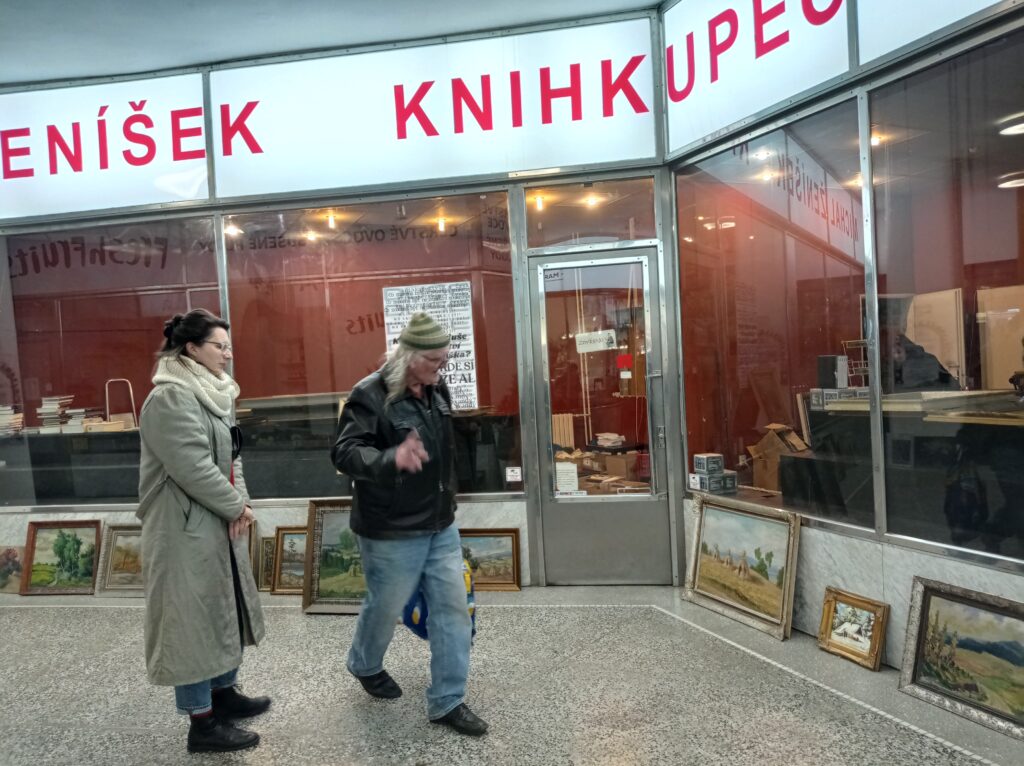
I’m reminded of a moment when he confided his frustration: customers at the bookshop often mistook his painting collection for items for sale. He’d have to explain, again and again, that none of them were—these paintings were part of the bookshop’s fabric. And yet, he would sometimes add, as if he didn’t quite mean it, that perhaps he might part with them for a good price.
A bottle of wine sits within reach. He suggests we share a drink—to toast the moment. So we do. We raise our glasses to the closing of the bookstore, to the end of what may have been the most significant chapter of his life. Grief lingers in the air, unspoken, with no words that could soften it. And yet, our unexpected presence—bearing witness to this moment—carries a quiet magic. We all feel it, though no one says a thing.
Pan Ženíšek had built something none of us had: a bookstore with history and a soul of its own. Now, he was saying goodbye. It was a reminder that everything changes, that everything is impermanent—including us.
I felt like an episodic character in the story of the bookstore—someone who appeared only near the end. And yet, in that moment, I realized how much that ending needed witnesses. If I hadn’t helped him that day, maybe those paintings would’ve stayed on the walls until the landlord took them down. Maybe no one would’ve remembered what they meant, or how they’d once hung above shelves filled with books and stories and laughter. Maybe no one would’ve paused to say goodbye.
And selfishly, I needed that goodbye too. While the bookstore was closing, something in me was just starting. I was no longer drifting in limbo—I was part of something, even if only briefly. Helping him felt like anchoring myself, however loosely, to a piece of Brno’s soul.
Fast forward to 2024. I walk through Alpha Passage again. Where the bookshop once stood, there’s now a hip café, packed with people. Yet another reminder of how Brno keeps reshaping itself.
I stop at the entrance but don’t go in. I just stand there, watching. I think of Pan Ženíšek, the paintings, the books, the cigarette smoke curling in the dark. And I realize: this is Brno too. A city where stories don’t just unfold—they linger. They hang in the air, between shelves that no longer exist, in the light of a screen in an empty room.
I haven’t seen Pan Ženíšek since the day we sold his paintings. Now and then, I catch glimpses of his posts on social media—nostalgic throwbacks to the golden days of the bookstore and the people who passed through it.
Sometimes I wonder if he ever walks past the café, or if he prefers to remember it as it was—lined with bookshelves, filled with opera music, and brimming with stories. For me, the shop lives on not just in memory, but in the way I move through cities now: slower, more alert, as if every forgotten corner might be a stage, every quiet figure behind a counter a keeper of something rare. Pan Ženíšek may have closed his bookshop, but he opened a chapter in me that’s still being written.
Author’s Note
This story was written in 2024, reflecting on events from January 2023, and was submitted in 2025 to the Brno Short Story Writing Contest.
Written before Michal Ženíšek’s passing and published only now, this personal essay has unexpectedly become a tribute to one of Brno’s most beloved booksellers. Michal Ženíšek passed away in Brno on 28 July 2026 at the age of 73.
Readers interested in the beginning of our story may also enjoy my earlier article, How I Discovered Brno’s Legendary Bookstore and Its Equally Legendary Owner, published in 2022.
